
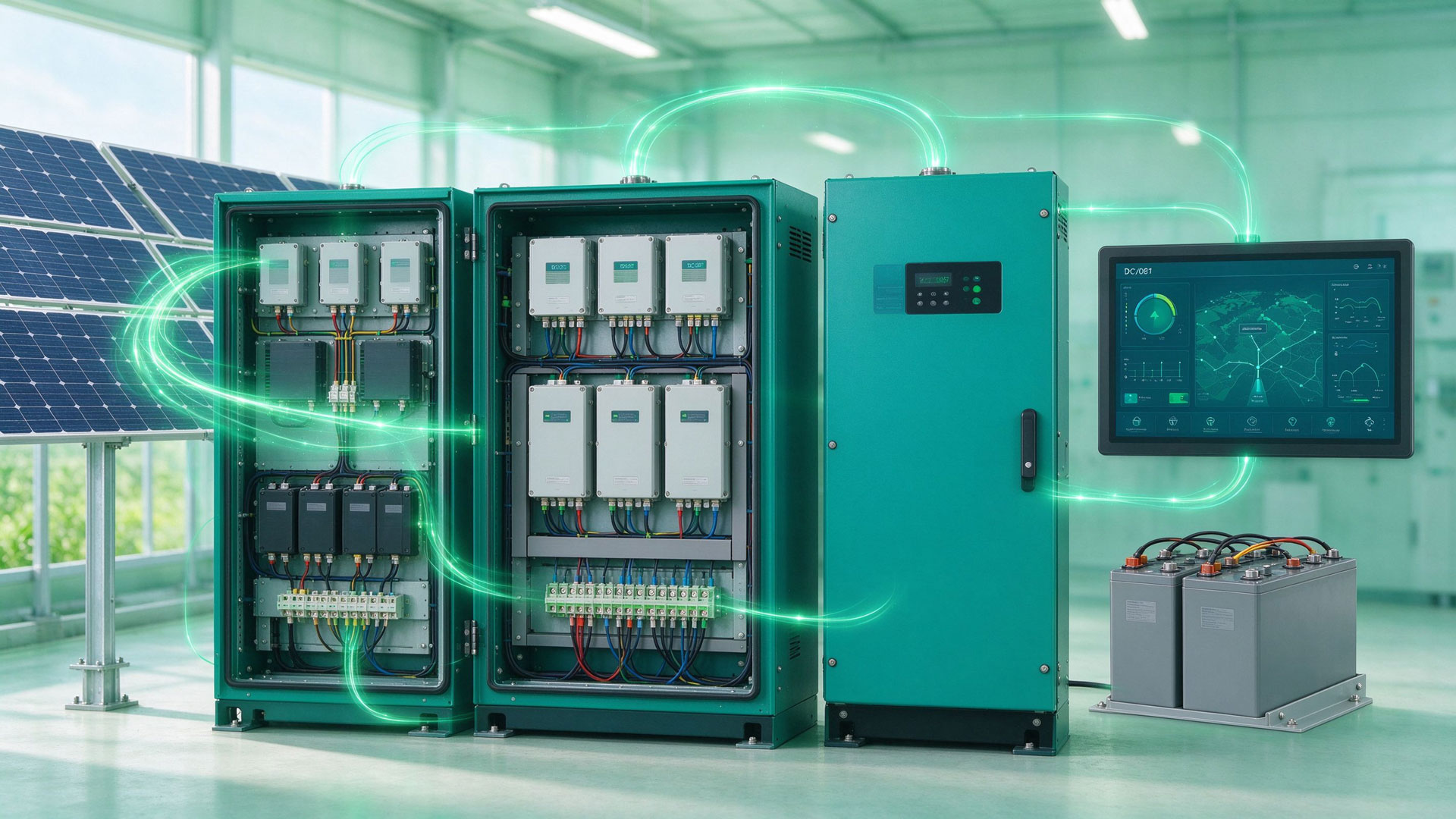
PV Energy Storage DC/DC Power Modules Support Efficient Operation of Renewable Generation Systems
In PV and energy storage systems, DC/DC modules handle battery voltage conversion, bus voltage regulation, auxiliary power and control circuit supply, linking PV arrays, batteries, inverters and monitoring systems. PV modules need wide input voltage adaptation and MPPT support, while storage modules emphasize bidirectional conversion, efficient charge-discharge operation and BMS coordination. These modules focus on high efficiency, high isolation, thermal design, reliability and grid environment adaptability, playing an important role in improving generation efficiency and operational stability of renewable plants.
As PV installed capacity continues to grow, requirements on power components in PV inverters, combiner boxes, storage converters and plant monitoring systems are also rising. DC/DC power modules do not cover the entire main power conversion chain in these systems, but they supply stable power to control circuits, drive circuits, sampling circuits, communication units and auxiliary systems, while also performing voltage matching and bus regulation in some topologies. The long-term stable operation of PV and energy storage systems depends heavily on the reliable performance of these auxiliary power and conversion units.
In PV systems, the output voltage of modules fluctuates with irradiance, temperature and load. DC/DC modules must adapt to a wide input voltage range and provide stable power for controllers, sampling circuits, communication modules and protection circuits. In systems with MPPT capability, power modules cooperate with control loops to track maximum power, ensuring the inverter continuously operates at the optimal power point. If the auxiliary power is unstable, control errors, sampling deviations, communication interruptions or false protection may occur.
Energy storage systems place more complex demands on DC/DC modules. Battery voltage varies widely during charging and discharging, so modules need wide input adaptability and efficient bidirectional conversion. During charging, the system converts bus energy into battery voltage; during discharging, it converts battery voltage into bus voltage. Some storage converters also require modules to supply the BMS, sampling units, protection circuits and communication systems, ensuring battery status monitoring and balancing control remain functional.
Electrical safety is equally important. Both PV arrays and storage batteries involve high DC voltages, so the system must provide reliable isolation, insulation monitoring, reverse polarity protection, overcurrent protection and fault shutdown. DC/DC modules usually need high isolation voltage to prevent faults on the high-voltage side from spreading to the low-voltage control side. Plant environments are often outdoor or semi-outdoor, with complex temperature, humidity, dust and electromagnetic conditions, so products require good thermal design, environmental protection and long-life components.
From a system operation perspective, the efficiency of PV energy storage DC/DC modules directly affects self-consumption losses. Although auxiliary power is relatively small, it operates continuously for long hours, so cumulative losses cannot be ignored. High-efficiency modules reduce self-heating, ease thermal stress and improve overall plant generation efficiency. Module reliability and fault response speed also affect operational cost, especially in large PV and storage plants, where a single point of failure may cause downtime or expensive repairs.
Going forward, PV energy storage DC/DC modules will develop toward higher efficiency, higher integration, intelligent diagnosis and closer BMS coordination. As PV and storage integration deepens, modules will not only supply power but also become important nodes in system monitoring, fault warning and energy management networks, helping renewable plants achieve higher efficiency and lower operational cost.